# Tent and Caravan Awning Fabrics Explained: Polyester, Acrylic, Canvas and PVC Compared **By Martin Miller \| OUTDOOR SEWING SOLUTIONS**

posted in: Contract Sewing | 0

Blog 2 of 5 in our series on tent and caravan awning fabrics.

Choosing a tent or caravan awning involves more than deciding on its size, colour or price\. The fabric is one of the most important factors affecting how a product performs, how easy it is to handle, how comfortable it feels and how it responds to prolonged outdoor exposure\.

But with manufacturers using different materials, coatings and fabric constructions, how do you know which is right for you?

At OUTDOOR SEWING SOLUTIONS, we repair tents, caravan awnings and other outdoor fabrics\. We see how different materials behave in practical use, including how they can deteriorate and when they may no longer be suitable for repair\.

In this article, we explain the main types of fabric used in tents and caravan awnings, their advantages and limitations, and what to consider before buying\.

There is no single material that is best for every application\. The right choice depends on how you intend to use your equipment and the balance you need between weight, comfort, weather resistance, durability and maintenance\.

## 1\. Polyester: lightweight and practical

Polyester is widely used in modern tents and caravan awnings, particularly where low weight and ease of handling are important\.

It is a synthetic fibre that can be woven into different weights and constructions, then treated or coated to improve particular properties\.

### Advantages of polyester

– **Lightweight:** Often easier to carry, erect and pack away than heavier fabrics\.
– **Quick drying:** Generally dries relatively quickly when compared with absorbent cotton canvas\.
– **Versatility:** Can be manufactured in a wide range of weights, weaves and colours\.
– **Weather protection:** Suitable coatings and treatments can provide effective resistance to rain and moisture\.
– **Practical for touring:** Particularly useful for products that are regularly erected and dismantled\.

### What are its limitations?

Not all polyester fabrics perform in the same way\. Their properties depend on the yarn, weave, coating, UV protection and overall construction\.

Prolonged exposure to sunlight can gradually weaken susceptible polyester fabrics and may affect their coatings\. Some lightweight fabrics are therefore better suited to occasional camping than to continuous outdoor pitching\.

This does not mean polyester is unsuitable for outdoor use\. It means the particular fabric needs to be matched to the intended application\.

### Is a higher\-denier polyester always better?

Denier describes the linear mass of the yarn, rather than measuring the complete fabric’s strength or expected lifespan\.

A higher\-denier fabric may use thicker yarn, but durability also depends on the weave, fibre properties, coating and construction\. A lighter fabric with a carefully designed construction may perform better in a particular application than a heavier alternative\.

When comparing products, look beyond the denier figure and ask what the complete fabric is designed to do\.

## 2\. Acrylic: valued for colourfastness and outdoor performance

Acrylic fibres are used in a range of outdoor fabrics, including some caravan awnings and shade products\.

One important characteristic is colourfastness, particularly when the fibres are solution\-dyed\.

### What does solution\-dyed acrylic mean?

In solution dyeing, colour pigments are incorporated into the material before the fibre is formed\. This differs from processes where colour is applied later in production\.

The method can provide excellent resistance to fading, although the actual performance depends on the fibre, manufacturing process and exposure conditions\.

Solution\-dyed acrylic is often selected for products where retaining colour and appearance during extended outdoor use is important\.

### Advantages of acrylic fabrics

– Good colourfastness, particularly with solution\-dyed fibres\.
– Useful resistance to UV\-related fading\.
– A fabric construction that can provide a comfortable balance of weight, flexibility and durability\.
– Suitability for certain products intended for extended outdoor use\.

### What should you consider?

The word *acrylic* does not automatically guarantee a particular level of performance\.

An acrylic fibre fabric is not the same thing as polyester fabric with an acrylic coating\. These are different constructions with different characteristics\.

The fabric’s specification, intended use, stitching and other components still matter\. Acrylic fabrics can also suffer from abrasion, contamination, mechanical damage and general ageing\.

For customers planning to leave an awning erected for long periods, it is worth investigating whether the particular product uses solution\-dyed acrylic and what the manufacturer says about its intended use\.

## 3\. Cotton canvas: traditional, breathable and comfortable

Cotton canvas has a long history in tent manufacture\. It remains valued for its natural feel and breathability\.

Unlike many coated synthetic fabrics, untreated woven cotton allows moisture vapour to pass through the fabric, helping to manage condensation in suitable conditions\.

### Advantages of cotton canvas

– Breathability that can help create a comfortable living environment\.
– A substantial, traditional fabric feel\.
– Good performance in appropriately designed and maintained products\.
– The ability of cotton fibres to swell when wet, helping close small gaps in the weave\.

### What are the limitations?

Cotton canvas is generally heavier than comparable lightweight synthetic fabrics and can take longer to dry\.

It also needs careful moisture management\. Storing cotton canvas while damp can encourage mould and mildew, potentially leading to staining and deterioration\.

Cotton canvas may require an initial weathering process, depending on its construction and the manufacturer’s instructions\. This allows the fibres to swell and helps close small gaps in the weave\.

It is important to follow the instructions supplied with the specific product rather than assume that every canvas tent should be treated identically\.

Cotton canvas can offer a long working life when appropriately designed, used and maintained, but it is not maintenance\-free\.

## 4\. Polycotton: combining natural and synthetic fibres

Polycotton combines cotton and polyester to bring together some of the characteristics of both fibres\.

It is commonly used in larger family tents and other products where comfort and breathability are important\.

The proportions of cotton and polyester vary between products, so it is worth checking the actual specification rather than assuming every polycotton fabric is the same\.

### Advantages of polycotton

– Often more breathable than fully coated polyester fabrics\.
– Can help create a more comfortable internal environment\.
– Generally lighter than an equivalent all\-cotton construction, although weight varies considerably\.
– Can combine the feel of canvas with some of the practical benefits of synthetic fibres\.

### What should you consider?

Polycotton still needs appropriate drying and storage\. The cotton content can absorb moisture, and the fabric may take longer to dry than lightweight polyester\.

Some polycotton products use water\-repellent treatments, but the details vary\. These treatments should not be confused with the waterproof coatings used on many synthetic flysheets\.

Construction also matters\. Water can enter through needle holes or seams if the product has not been designed or prepared correctly for its intended use\.

For customers who value comfort and breathability, polycotton can be an attractive choice\. The trade\-off may be additional weight, drying time and maintenance\.

## 5\. PVC\-coated fabrics: robust and weather\-resistant

PVC, or polyvinyl chloride, is widely used as a coating on outdoor textiles\.

In many cases, the fabric consists of a woven synthetic base, often polyester, with PVC applied to provide weather resistance and a durable outer surface\.

PVC\-coated fabrics are used in a wide range of applications, including heavy\-duty covers, marquees and some awning components\.

### Advantages of PVC\-coated fabric

– Can provide a highly weather\-resistant surface\.
– Available in robust constructions for demanding applications\.
– Often easy to wipe clean when the material and contamination allow\.
– Can be manufactured in different weights and finishes to suit particular uses\.

### What are its limitations?

PVC\-coated fabric is not automatically the best choice for every tent or awning\.

Its surface can behave differently from a breathable textile\. Depending on the design and conditions, condensation may need to be managed through ventilation\.

The coating can also be affected by ageing, repeated folding, abrasion, unsuitable cleaning chemicals and prolonged environmental exposure\.

The base fabric, coating formulation, reinforcement and seams all contribute to performance\. Two PVC\-coated materials can therefore have very different properties\.

Although PVC is often associated with heavy\-duty applications, its expected working life still depends on the product specification and how it is used\.

## 6\. Nylon: another fabric used in lightweight tents

Although this article focuses on the main materials used in many caravan awnings and outdoor fabrics, nylon is also worth mentioning\.

Nylon is commonly used in lightweight backpacking and specialist tents because it can offer a useful balance between low weight and strength\.

It usually relies on suitable coatings or treatments to provide the required water resistance and other performance characteristics\.

Like polyester, nylon is not a single uniform material\. Its performance varies with the yarn, weave, coating, design and exposure\.

The most appropriate choice depends on the demands of the activity, including the need to minimise weight\.

## 7\. Fabric coatings: what lies beneath the surface?

One of the most important things to understand is that the fibre alone does not determine how a tent or awning performs\.

A fabric may have a coating or treatment designed to improve water resistance, reduce surface wetting or provide other benefits\.

Common examples include polyurethane (PU), PVC and acrylic coatings, alongside durable water\-repellent treatments\.

These perform different functions and should not be treated as interchangeable\.

For example, a waterproof coating can help prevent rain from passing through a fabric, while a water\-repellent treatment may help water bead on the surface\. The performance and durability of either depend on the particular product and its condition\.

Coatings can also age\. A fabric may remain intact while its coating begins to deteriorate, or the base material itself may lose strength\.

This is one reason why an inspection should consider the whole fabric construction rather than its surface appearance alone\.

## 8\. What about denier, fabric weight and waterproof ratings?

Product descriptions can contain several technical figures\. Understanding what they mean can help you compare like with like\.

### Denier

Denier relates to the mass of the yarn over a specified length\. It can help describe the yarn used in certain synthetic fabrics, but it does not provide a complete measure of fabric strength or durability\.

### Fabric weight

Fabric weight is often expressed in grams per square metre (gsm)\.

A heavier fabric may be more substantial, but weight alone does not establish its resistance to UV damage, tearing, coating failure or other forms of ageing\.

### Waterproof ratings

Some fabrics are tested for water resistance using a hydrostatic\-head measurement, commonly expressed in millimetres or kilopascals\.

This indicates how much water pressure the fabric can withstand under the specified test conditions\. It does not, by itself, tell you how long the fabric will remain waterproof or how well it will withstand sunlight and repeated use\.

### Ripstop construction

Ripstop fabrics use a reinforced weave pattern designed to help limit the spread of tears\.

This can be useful, particularly in lightweight applications, but the term does not guarantee that a fabric cannot tear\. The underlying material and construction still matter\.

When comparing products, check what each specification measures and whether the figures relate to the same type of test\.

## 9\. Which fabric is best for your tent or caravan awning?

The best choice depends on your priorities and how you intend to use the product\.

|Your priority |Materials worth investigating |
|——————————————–|———————————————————————-|
|Low weight and easy handling |Lightweight polyester or nylon, depending on the product |
|Occasional touring |Suitable touring-grade polyester or other lightweight constructions |
|Breathability and comfort |Cotton, polycotton or suitable breathable synthetic fabrics |
|Colour retention during extended outdoor use|Solution-dyed acrylic or other fabrics with appropriate UV performance|
|Heavy-duty weather protection |Suitable PVC-coated or other purpose-designed technical fabrics |
|Extended or seasonal pitching |Products specifically designed and rated for that intended use |

These are starting points, not a universal ranking\. Individual products can differ substantially, and a fabric that performs well for one application may not be the most suitable for another\.

It is also worth remembering that a caravan awning may use different materials for its roof and side panels\. Ask for the specification of each where it matters to your buying decision\.

## 10\. How long will each fabric last?

This is understandably one of the most common questions, but there is no reliable universal lifespan that can be assigned to each material\.

Two polyester fabrics may differ significantly in their construction and protective treatments\. The same is true of acrylic, polycotton and PVC\-coated materials\.

Useful questions to ask include:

– What is the fabric’s exact composition and construction?
– Is it designed for occasional touring, repeated pitching or extended use?
– What information is available about UV resistance and weathering?
– What care and storage instructions apply?
– Are replacement panels and professional repairs available?

Years of ownership are not the same as weeks of outdoor exposure\. The intensity of sunlight, the conditions in which the fabric is used and the way it is maintained can all influence its working life\.

Our first article in this series explains this distinction in more detail:

[How Long Should a Tent or Caravan Awning Last? Understanding the True Lifespan of Outdoor Fabrics](https://outdoorsewingsolutions.co.uk/how-long-should-a-tent-or-caravan-awning-last-understanding-the-true-lifespan-of-outdoor-fabrics/)

## 11\. Can good maintenance make a difference?

Yes\. Appropriate maintenance can help prevent avoidable damage and preserve a fabric’s condition\.

Keep fabrics clean using suitable products, dry them thoroughly before storage, and follow the manufacturer’s recommendations for cleaning and protective treatments\.

Inspect seams, stitching, attachment points and high\-stress areas regularly\. Small problems can sometimes be repaired before they develop into more extensive damage\.

However, maintenance cannot reverse advanced UV degradation or restore the original strength of a severely weakened material\.

We will explore cleaning, drying, storage, mould, mildew and preventative care in the final article of this series\.

## Our advice from OUTDOOR SEWING SOLUTIONS

There is no single fabric that is best for every tent, caravan awning or outdoor cover\.

Lightweight synthetic materials can make touring easier\. Breathable cotton and polycotton can provide a comfortable environment\. Solution\-dyed acrylic offers valuable colourfastness, while PVC\-coated fabrics can be suitable for robust, weather\-resistant applications\.

The important thing is to understand the complete construction and choose a product that matches your intended use\.

At OUTDOOR SEWING SOLUTIONS, our repair work gives us practical insight into how outdoor fabrics behave over time\. We believe customers benefit from understanding both the advantages and limitations of the materials they buy\.

**Choose the right fabric for the job, follow the manufacturer’s care instructions and assess condition rather than relying on age or appearance alone\.**

### Coming next: Which caravan awning brands and fabrics are worth considering?

In Blog 3, we will look at caravan awning manufacturers and their published fabric specifications, including the differences between touring and extended\-use products\.

Our aim is to help customers ask better questions and make informed choices, without suggesting that any one manufacturer or material is automatically right for everyone\.

**Need help with a tent or awning repair?**

OUTDOOR SEWING SOLUTIONS provides specialist sewing, repair and alteration services for tents, caravan awnings and other outdoor fabrics\.

If you have a damaged panel, failed seam, broken zip or fabric that may have deteriorated, contact us to discuss whether a repair is practical\.

Visit [OUTDOOR SEWING SOLUTIONS](https://outdoorsewingsolutions.co.uk/) to find out more\.
How Long Should a Tent or Caravan Awning Last? Understanding the True Lifespan of Outdoor Fabrics

posted in: Contract Sewing | 0

By Martin Miller | OUTDOOR SEWING SOLUTIONS

Blog 1 of 5 of this series.

A tent or caravan awning can look almost new yet have already suffered significant deterioration. Another, several years older, may still have plenty of useful life left.

Why is there such a difference?

At OUTDOOR SEWING SOLUTIONS, we repair tents, caravan awnings and other outdoor fabrics. Through this work, we see how materials perform over time, including cases where the fabric has deteriorated beyond economical repair while other components remain in good condition.

One of the most important factors is exposure to ultraviolet (UV) radiation from the sun. However, fabric type, construction, weather conditions, maintenance and intended use all play a part.

Understanding these differences can help you choose the right product, look after it properly and make a more informed decision when buying a new or ex-display tent or awning.

Years of ownership versus weeks of outdoor exposure

When we ask how long a tent should last, we usually think in years. Manufacturers and retailers may discuss warranties, expected service life or the number of camping trips a product should withstand.

But there is another way of looking at the problem: how much time has the fabric actually spent exposed to the elements?

Consider two identical tents.

One is used for two weeks each summer, then dried, packed away and stored correctly. The other remains erected outdoors throughout the summer, exposed to daylight, rain, wind and changing temperatures.

Both tents might be four years old, but their exposure histories are very different.

This is why it is useful to distinguish between:

● Calendar age: the time since the product was purchased.

● Actual use: the time spent camping or using the awning.

● Outdoor exposure: the time the fabric spends outdoors, including periods when the product is not being used.

These are different measurements. Outdoor exposure can be a useful indicator of potential deterioration, but it cannot predict the exact lifespan of an individual product.

The intensity of sunlight, the fabric’s protective treatments, the season, the environment and the way the product is maintained all influence the outcome.

Can a lightweight tent really have a lifespan of just 8–10 weeks?

This is a question worth exploring.

Outdoor World Direct published an article about UV degradation in lightweight 70-denier polyester tents. Drawing on the author’s experience in the camping equipment industry, it gives an estimate of approximately 8–10 weeks of outdoor exposure in UK fair-weather conditions for this category of tent.

At first glance, that sounds remarkably short.

However, the estimate is specific to a lightweight tent category and reflects professional experience rather than a universal laboratory-tested lifespan.

The article also explains that someone using a tent for approximately two weeks a year might obtain around four years of use under suitable conditions.

You can read the original article here:

The Effect of UV Degradation on 70-Denier Tents — Outdoor World Direct

The important lesson is not that every tent lasts only 8–10 weeks. It is that a lightweight touring or adventure tent should not automatically be assumed suitable for continuous outdoor display or long-term pitching.

Different products are designed for different purposes, and their fabrics are selected accordingly.

What does sunlight actually do to tent and awning fabric?

Sunlight contains ultraviolet radiation, which can gradually damage susceptible textile fibres, coatings and other materials.

Depending on the construction and protective treatments, prolonged exposure can contribute to:

● Fading or changes in colour.

● Loss of fabric strength.

● Increased brittleness.

● Greater susceptibility to tearing.

● Deterioration of waterproof coatings.

● Weakening of some components and seams.

The deterioration may not be obvious at first. A fabric can remain reasonably presentable while losing some of its original strength.

Eventually, a panel may split under tension, sometimes around a seam, corner, window or attachment point. These areas can experience additional stress during use.

UV degradation is not the only cause of fabric failure. Abrasion, wind loading, incorrect tension, trapped moisture, unsuitable cleaning products and general ageing can also contribute.

The condition of the whole product therefore matters, not just its appearance.

Does a heavier fabric always last longer?

Fabric weight is one consideration, but it does not tell the whole story.

Denier is a measurement relating to the linear mass of a yarn. It is useful when comparing certain synthetic fabrics, but a higher denier figure does not automatically guarantee a longer service life.

Other factors include:

● The type and quality of the fibres.

● The weave or knitted construction.

● UV stabilisers and other protective treatments.

● Waterproof coatings and their durability.

● The quality of stitching and other construction details.

● The intended use of the product.

Two fabrics with similar weights can perform differently because their construction and treatments differ.

This is why it is worth looking beyond a single specification when comparing tents or caravan awnings.

How do polyester, acrylic, canvas and PVC compare?

Different materials have different strengths. The best choice depends on whether you need a lightweight touring product, an awning for longer stays, a breathable living space or a heavy-duty outdoor cover.

Lightweight polyester

Lightweight polyester is popular for touring tents because it is relatively easy to handle, transport and erect.

Its performance depends on the yarn, weave, coating and UV protection used. Prolonged exposure to sunlight can eventually weaken susceptible fabrics, particularly where the product is not intended for continuous pitching.

For occasional camping, lightweight polyester can be a practical choice. It should not automatically be judged against the requirements of a permanently erected structure.

Heavier polyester and specially treated fabrics

Heavier polyester fabrics and products with specialised coatings or UV-protective treatments may be designed for more demanding applications.

However, weight and price alone cannot establish how long a particular fabric will last. The complete specification and the manufacturer’s guidance are more useful.

Acrylic and acrylic-coated fabrics

Acrylic is valued for its colourfastness and resistance to UV-related fading. Some outdoor fabrics combine acrylic with other fibres or use protective coatings, so it is important to identify the actual material construction.

Acrylic fabrics can be a good option for applications involving extended outdoor exposure, but they are not immune to ageing, contamination, abrasion or damage.

Cotton and polycotton canvas

Cotton and polycotton fabrics are often selected for their breathability and comfort, particularly in larger family tents and products intended for longer stays.

Their performance depends on their construction, treatment and maintenance. They also need appropriate drying and storage to avoid moisture-related problems.

Breathability and UV resistance are valuable properties, but neither means a fabric can be left indefinitely without care.

PVC and vinyl-coated fabrics

PVC-coated materials are widely used where weather resistance and durability are important.

The quality of the base fabric, coating, reinforcement, seams and UV stabilisation all influence performance. Folds, abrasion, environmental conditions and unsuitable cleaning chemicals can also affect service life.

PVC should not automatically be assumed to last a particular number of years simply because it is a heavier or coated material.

We will explore these materials in greater detail in our next article.

What about caravan awnings?

Caravan and motorhome awnings present a slightly different challenge because they vary considerably in their design and intended use.

A lightweight touring awning may be erected for a holiday, packed away and stored until the next trip. Another awning may be used for extended stays or remain erected for much longer periods.

These products can have very different requirements.

When choosing an awning, consider:

● Intended use: Is it designed for touring, seasonal use or longer-term pitching?

● Fabric construction: What material is used for the roof and side panels?

● Breathability: Is this important for your style of camping?

● Weather resistance: What guidance does the manufacturer provide for wind, rain and prolonged exposure?

● Repairability: Are replacement panels, parts and professional repair services available?

● Maintenance: What cleaning and storage procedures does the manufacturer recommend?

There is no single material that is automatically best for every customer.

A lightweight, easy-to-handle awning may be ideal for frequent touring, while another construction may be more suitable for someone who spends extended periods on a seasonal pitch.

The important thing is to match the product to the job.

Are expensive tents and awnings always more durable?

Not necessarily.

Price can reflect many things, including size, design, features, manufacturing methods, materials and the intended market. It does not provide a reliable lifespan guarantee on its own.

Likewise, a product made from a lighter fabric is not necessarily poorly made. It may have been designed to meet the needs of customers who prioritise low weight and ease of use.

Before buying, ask the retailer or manufacturer:

1. What is the exact fabric used for the roof and side panels?

2. Is the product designed for occasional touring or extended outdoor pitching?

3. What information is available about UV resistance and durability?

4. What maintenance is recommended?

5. What does the warranty cover, and what exclusions apply?

6. Are replacement parts and professional repairs available?

These questions will help you assess whether a product is appropriate for your needs.

Can you extend the life of a tent or caravan awning?

Yes, sensible maintenance can help preserve a product’s condition and prevent avoidable damage.

However, maintenance cannot reverse advanced UV degradation or restore the original strength of severely weakened fabric.

Here are some important principles:

Keep it clean. Dirt and contamination can affect fabrics and may encourage moisture retention. Use cleaning products suitable for the material and follow the manufacturer’s instructions.

Dry it thoroughly before storage. Packing away a wet tent or awning can create conditions that encourage mould and mildew. Moisture management is particularly important with cotton and polycotton materials.

Inspect it regularly. Check seams, stitching, zips, webbing, attachment points and areas exposed to tension. Early attention to a small problem may prevent more extensive damage.

Store it appropriately. Follow the manufacturer’s guidance and avoid leaving the fabric damp or exposed to unnecessary heat and sunlight during storage.

Use protective treatments carefully. Not every fabric needs the same treatment. A suitable reproofing product may help restore water repellency where appropriate, but it will not repair material that has lost its structural strength.

We will cover these measures in our dedicated maintenance article later in this series.

When is a tent or awning beyond economical repair?

This is a question we regularly face in the repair trade.

A torn panel, damaged zip or failed seam may be perfectly repairable if the surrounding material remains sound.

The situation is different when the fabric itself has deteriorated extensively. Sewing a damaged area back together may simply transfer the stress to nearby weakened material, causing another failure.

In such cases, it is important to assess the condition of the fabric around the damage and consider whether a repair will provide a worthwhile result.

Our approach at OUTDOOR SEWING SOLUTIONS is to repair and restore outdoor equipment where practical, rather than recommend replacement unnecessarily. But an honest assessment must take account of the condition of the original material.

Sometimes a repair is the sensible option. Sometimes the fabric has reached the end of its useful life.

What about ex-display tents and awnings?

An ex-display product can represent excellent value, particularly if it has only been erected briefly or displayed indoors.

However, a product left outdoors for an extended period may have accumulated substantial exposure to sunlight and weather before its first owner ever takes it camping.

That does not mean every ex-display product is unsuitable. Its history and condition matter.

Before buying, ask how long it was displayed, whether it was outdoors, whether it was exposed to the elements continuously and what warranty remains.

Look for fading, unusual colour differences, brittle material, damaged seams and other signs of deterioration. Remember that the absence of obvious fading does not guarantee that the fabric is in perfect condition.

We discuss these issues in more detail in our guide:

Beware of Ex-Display Tents: Why That Summer Deal Might Cost You More

Our advice from the repair workshop

At OUTDOOR SEWING SOLUTIONS, we believe the best approach is to understand the material, use the product as intended and maintain it properly.

There is no universal lifespan for tents and caravan awnings. A product’s useful life depends on its design, materials, exposure, maintenance and the conditions in which it is used.

The key lesson is simple: judge an outdoor fabric by its construction, intended use, exposure and condition—not just its age, price or appearance.

Choosing the right product at the outset and looking after it properly can help you get the best value from your investment.

Coming next: Which outdoor fabric is right for you?

In the next article in our series, we will compare polyester, acrylic, cotton and polycotton canvas, and PVC in greater detail, explaining their advantages, limitations and suitability for different types of tents, caravan awnings and outdoor covers.

img_8192-1024x1024 How Long Should a Tent or Caravan Awning Last? Understanding the True Lifespan of Outdoor Fabrics

Need advice about a damaged tent or awning?

OUTDOOR SEWING SOLUTIONS provides specialist repairs and sewing services for outdoor fabrics. If your equipment has suffered a tear, damaged seam, failed zip or other problem, contact us to discuss whether a repair is practical.

Visit OUTDOOR SEWING SOLUTIONS to find out more.

DIY Cleaning Solutions for Awnings, Tents & Outdoor Fabrics – Recommended by Outdoor Sewing Solutions

posted in: Contract Sewing | 0

2497D568-EBB9-44BD-AC73-C95FD779884C-300x200 DIY Cleaning Solutions for Awnings, Tents & Outdoor Fabrics – Recommended by Outdoor Sewing Solutions
Keeping your outdoor equipment clean isn’t just about appearance—it’s one of the best ways to protect your investment and extend its lifespan.
At Outdoor Sewing Solutions, we are often asked if we offer an awning and tent cleaning service. The answer is no.
Our expertise is in the professional repair and restoration of outdoor fabrics. From caravan awnings and drive-away awnings to bell tents, safari tents, boat covers, glamping accommodation and commercial canvas products, we specialise in bringing damaged equipment back to life.
However, we know many of our customers enjoy maintaining their own equipment, so we’re pleased to recommend a range of professional-grade cleaning products from HLS Supplies, a trusted supplier already used by one of our commercial customers.
Professional Products for DIY Cleaning
Rather than using household detergents or harsh chemicals that can damage fabrics and waterproof coatings, we recommend using products specifically designed for outdoor fabrics.
Some of the products we recommend include:
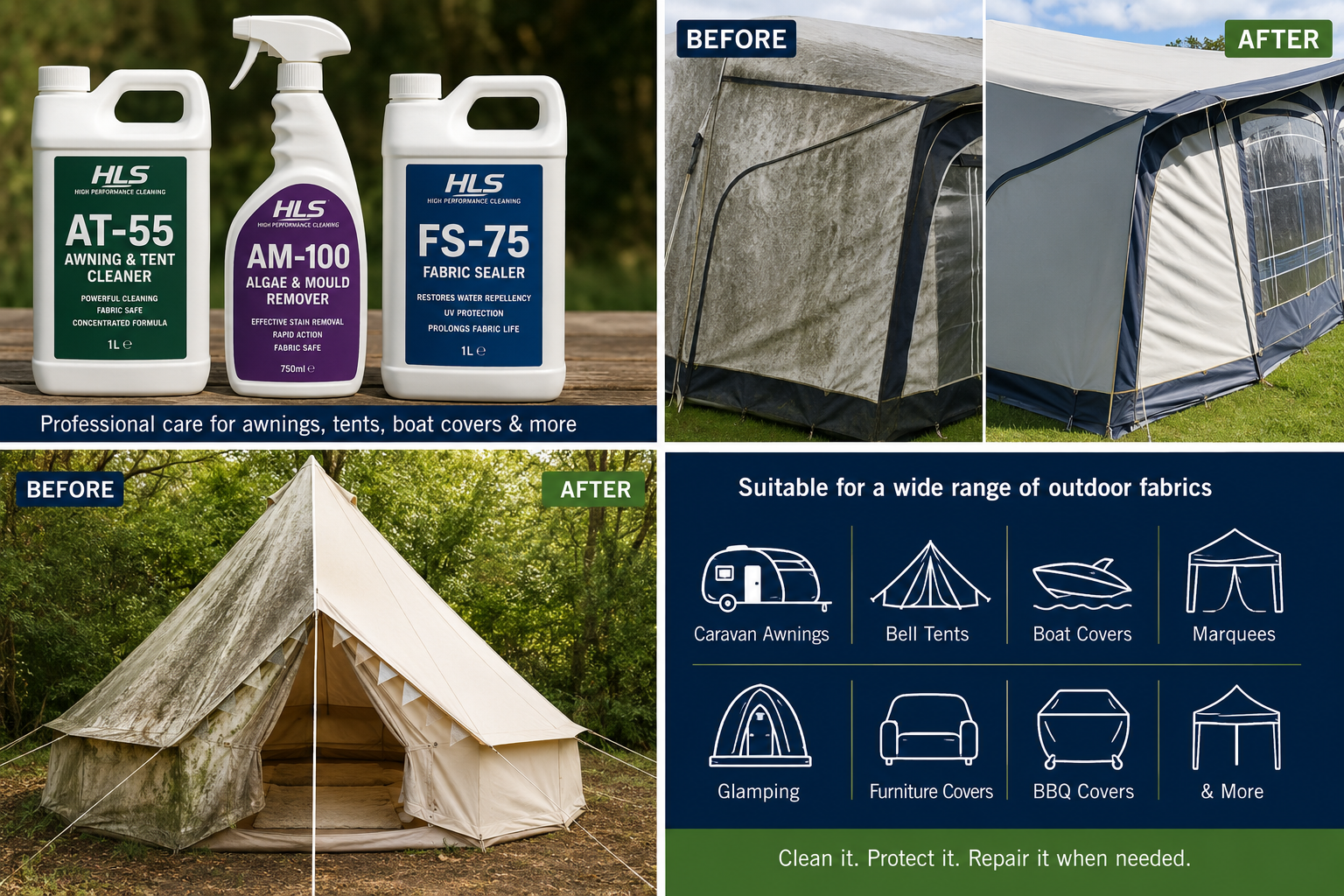
AT-55 Awning & Tent Cleaner
A concentrated cleaner developed for outdoor fabrics including:
● Caravan awnings
● Motorhome awnings
● Bell tents
● Canvas tents
● Gazebos
● Boat covers
● Outdoor furniture covers
● Tarpaulins
● Glamping accommodation
It removes dirt, general soiling, algae and many mould stains while being suitable for canvas, cotton and synthetic fabrics when used as directed. (HLS Supplies)
AM-100 Algae & Mould Remover
For more stubborn mould and algae staining, HLS recommends following the initial clean with AM-100 to tackle marks that normal detergents may not completely remove. (HLS Supplies)
FS-75 Fabric Sealer
Cleaning can reduce the effectiveness of existing waterproof treatments. After your fabric has been cleaned and fully dried, a quality fabric sealer helps restore water repellency and provides ongoing protection against the elements. (HLS Supplies)
Products Suitable for Many Outdoor Fabrics
These products are ideal for many of the items we repair, including:
● Caravan awnings
● Motorhome awnings
● Drive-away awnings
● Bell tents
● Canvas tents
● Stretch tents
● Marquees
● Glamping accommodation
● Boat covers
● Cockpit covers
● Sprayhoods
● BBQ covers
● Outdoor furniture covers
● Commercial fabric structures
Why We Don’t Offer Cleaning
Cleaning outdoor fabrics properly requires specialist equipment, chemicals and processes that are very different from professional sewing and repairs.
Rather than trying to do everything, we’ve chosen to focus on what we do best—expert repairs, alterations and restoration.
By recommending quality DIY products, our customers can safely clean and maintain their own equipment, while knowing we’re here if repairs are ever needed.
Looking Ahead
We’re currently recommending these HLS products because we’ve been impressed with their quality and professional results.
If there’s enough customer demand, we’re considering stocking a selected range of these products in the future, making it even easier for Outdoor Sewing Solutions customers to maintain their outdoor equipment.
Need a Repair After Cleaning?
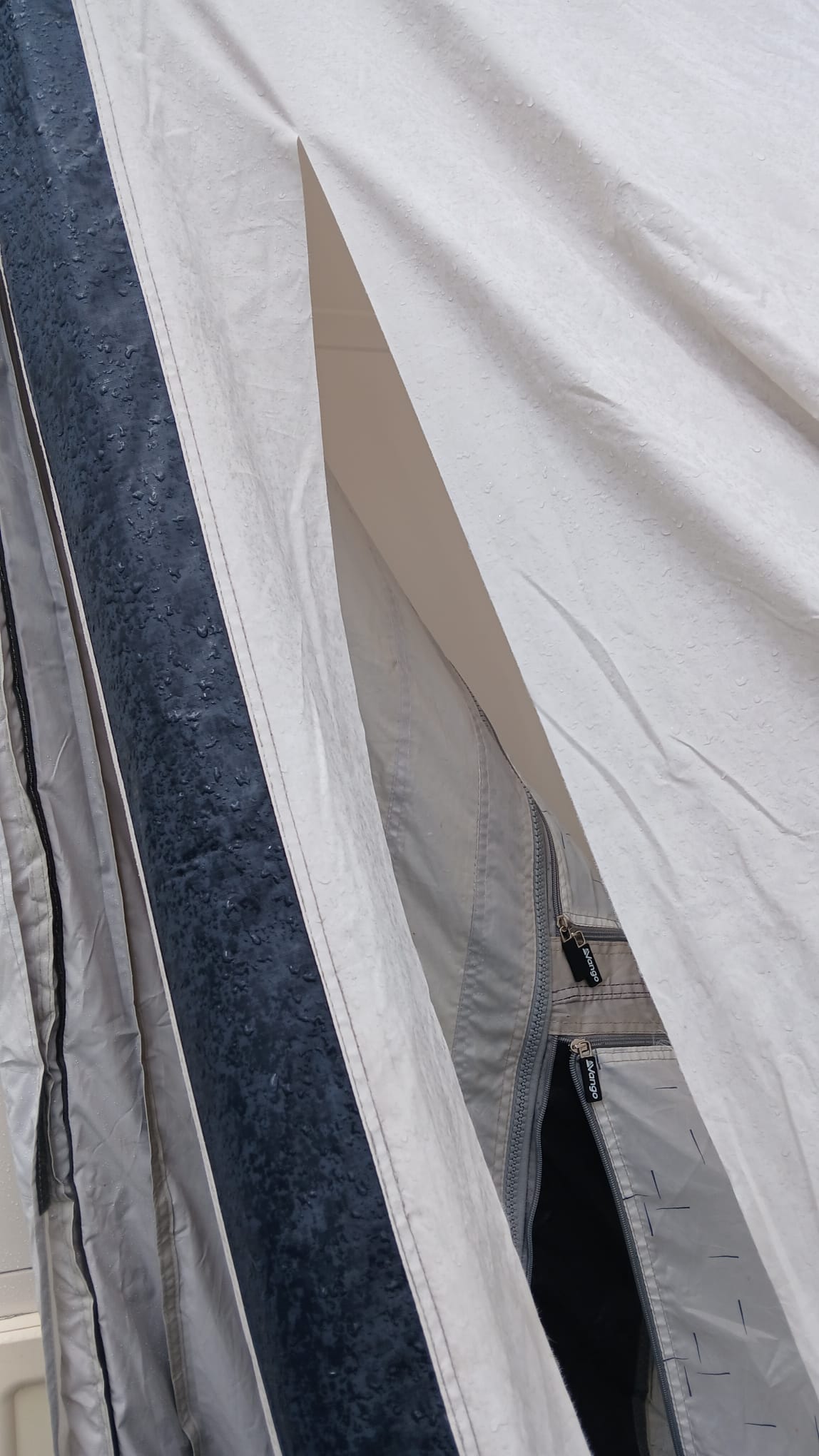
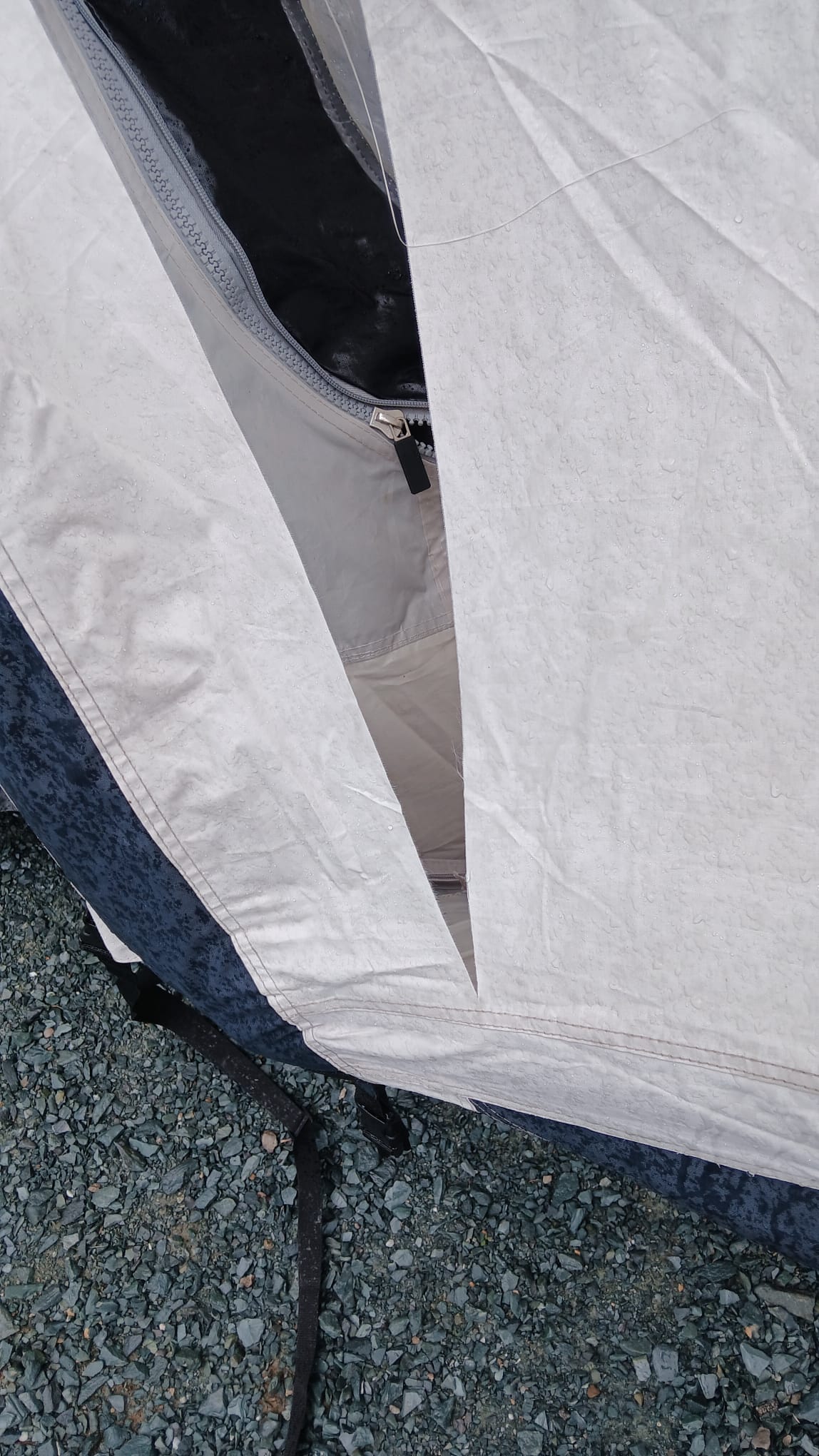
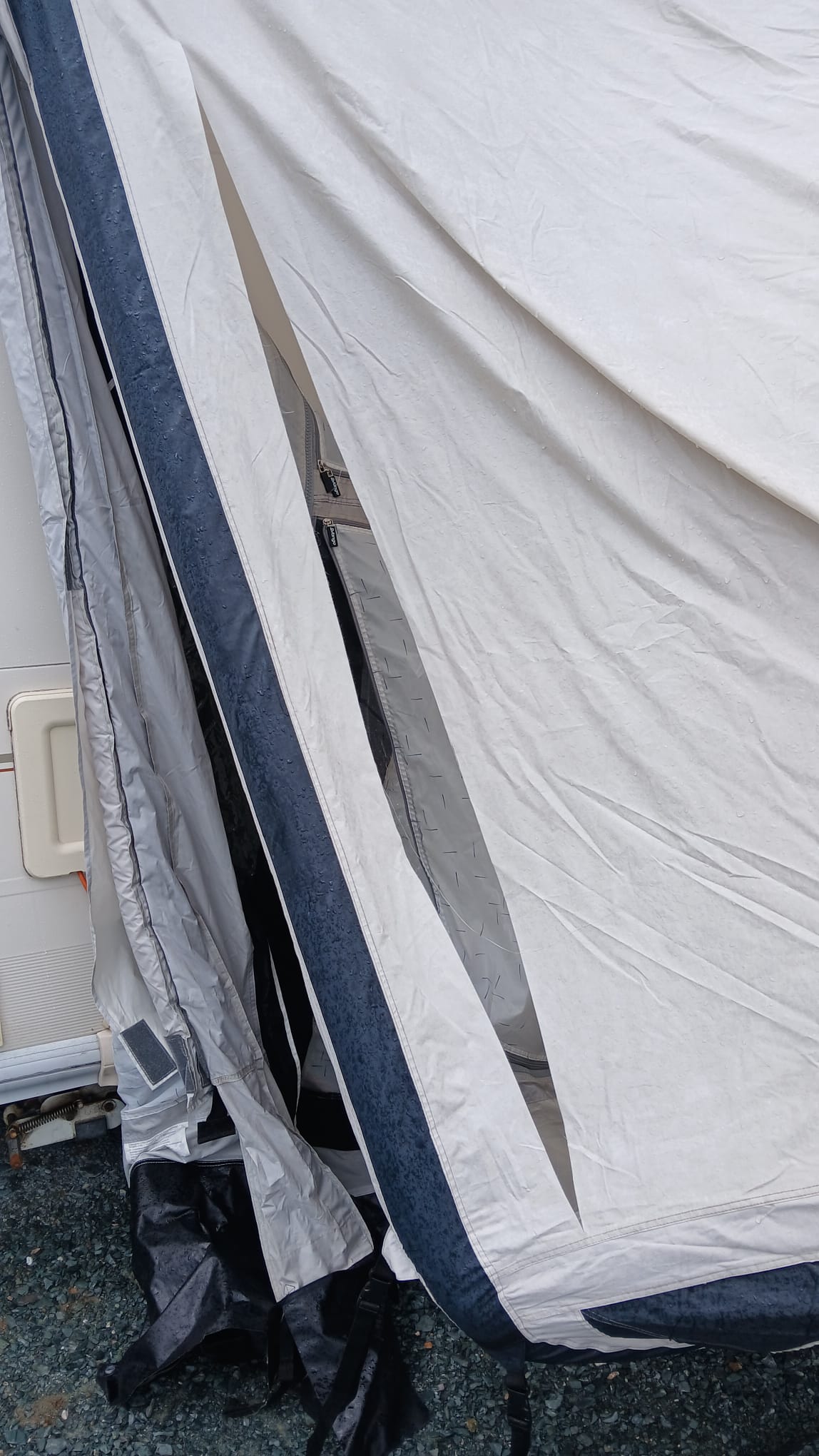
It’s surprising how often a good clean reveals hidden issues such as:
● Worn stitching
● Small tears
● Split seams
● UV damage
● Failing zips
● Damaged webbing
If you discover any of these problems after cleaning, don’t worry.
Outdoor Sewing Solutions offers professional repairs that can often add years of life to your equipment, saving the cost of replacement.
Whether it’s a family camping tent, a commercial marquee, a luxury bell tent or a caravan awning, we’re always happy to provide honest advice.
Clean it. Protect it. Repair it when needed. That’s the Outdoor Sewing Solutions approach.

Glamping Gear Care: Keep Your Luxury Camping Setup in Top Shape

posted in: Glamping | 0

Glamping combines the joys of camping with a touch of luxury, but those beautiful canvas tents, yurts, and bespoke outdoor furnishings need proper care to stay pristine. At Outdoor Sewing Solutions, based in Wetherby, North Yorkshire, we’ve been crafting and repairing heavy-duty outdoor textiles since 2014. Drawing from our expertise in contract sewing for glamping businesses, here are practical ideas to maintain your glamping gear, ensuring it remains both functional and fabulous for your guests.
1. Regular Cleaning for Canvas and Fabrics
Canvas tents and yurts are the heart of glamping, but dirt, sap, and moisture can dull their charm and weaken materials.
• How to clean: Use lukewarm water, mild soap (non-detergent), and a soft brush to gently scrub away dirt. Avoid harsh chemicals that can strip fire-retardant or waterproof coatings. Rinse thoroughly and air dry in a shaded area to prevent UV damage.
• Tackle mould early: If you spot mildew (common in the UK’s damp climate), use a diluted vinegar solution (1:10 with water) on affected areas, then rinse and dry completely.
• Pro tip: For large structures or stubborn stains, professional cleaning services can save time and protect delicate coatings. Our team offers tailored servicing for glamping setups—call us at 07764 679449 to discuss.
2. Inspect and Repair Seams and Fittings
High-quality stitching and fittings are critical for glamping gear, but wind, rain, and guest use can cause wear.
• Check seams and zippers: Look for fraying threads or loose stitching, especially around high-stress areas like doorways or guy lines. Test zippers for smooth operation; lubricate with silicone spray if needed.
• Examine poles and frames: Wooden or metal frames can crack or rust. Sand and repaint metal to prevent corrosion, and seal wooden poles with appropriate treatments.
• DIY vs. pro repairs: Small tears can be patched with canvas repair tape, but for larger damage or complex structures, our industrial sewing services use durable materials like heavy-duty threads or PVC to restore strength and aesthetics.
3. Protect Against Weather
The UK’s unpredictable weather—rain, frost, and UV exposure—can take a toll on glamping gear.
• Waterproofing: Reapply waterproof sprays (suitable for canvas or synthetic fabrics) annually to maintain resistance. Test for leaks by spraying water on the surface and checking for beading.
• UV protection: Prolonged sun exposure weakens fabrics. Consider UV-protectant sprays or store detachable fabric panels during off-seasons.
• Winter prep: If leaving tents up year-round, ensure proper ventilation to prevent condensation. For seasonal setups, dismantle and store in a dry, cool space to avoid mould.
4. Maintain Interior Furnishings
Glamping’s luxury lies in its cozy interiors—think cushioned seating, fabric linings, and decorative tarps.
• Clean upholstery: Vacuum fabric furniture regularly and spot-clean with upholstery-safe cleaners. For outdoor cushions, use removable, washable covers.
• Check for pests: Inspect for signs of rodents or insects, especially in stored gear. Use natural repellents like cedar blocks in storage areas.
• Refresh linings: Inner tent linings can trap odours. Air them out regularly and consider professional cleaning for a fresh guest experience.
5. Seasonal Storage Tips
When the glamping season winds down, proper storage extends gear life.
• Dry completely: Never store damp gear—mould grows fast. Use dehumidifiers in storage spaces if needed.
• Loose packing: Roll canvas tents or tarps loosely to avoid creases that weaken fibres. Store poles and frames upright or flat to prevent warping.
• Breathable bags: Use breathable storage bags for fabrics to allow air circulation, avoiding plastic that traps moisture.
6. Know When to Call the Experts
While DIY care handles basics, professional repairs ensure longevity for high-value glamping setups. At Outdoor Sewing Solutions, we specialise in crafting and repairing glamping tents, awnings, and custom covers. From reinforcing seams with Kevlar thread to creating bespoke textile solutions, we’ve got you covered. Based in North Yorkshire, we serve clients across the UK—reach out via our website or at 07764 679449 for a quote.
By following these care ideas, your glamping gear will stay luxurious and durable, delighting guests season after season. Happy glamping!
Outdoor Sewing Solutions – Crafting and caring for your outdoor adventures.

Beware of Ex-Display Tents: Why That Summer Deal Might Cost You More

IMG_0135-169x300 Beware of Ex-Display Tents: Why That Summer Deal Might Cost You More

Why Ex-Display Tents Are a Gamble
A typical camper uses their tent for about 4 weeks a year—weekends, short trips, or a family holiday.

A tent left outdoors for an entire summer can accumulate substantial exposure to sunlight and weather before it reaches its first owner. The effect depends on the fabric, UV protection, local conditions and how the tent is maintained. There is no reliable universal conversion between weeks on display and years of normal use.

Here’s what happens to those tents:
• UV Damage: Prolonged sunlight degrades synthetic fabrics like polyester and nylon, weakening the material and reducing its waterproofing. You might not see it at first, but the tent could tear or leak on your next trip.
• Mold and Mildew: Tents left pitched outdoors trap moisture, especially in humid or rainy conditions. This leads to mold or mildew, which can ruin the tent and make it unpleasant (or unsafe) to use.
• Worn Components: Zippers, poles, and guy lines suffer from constant weather exposure, becoming brittle or unreliable. A single storm could leave you with a collapsed tent.
• No Warranty, No Peace of Mind: Many ex-display tents are sold “as is,” with limited or no warranty. If issues arise, you’re often left to foot the repair bill.
What the Retailers Don’t Always Tell You
Some retailers, like Camping Recycled or Vango’s refurbished program, claim their ex-display tents are lightly used—sometimes only pitched for photos or short-term displays. They may even offer a 1-year warranty after professional refurbishment. But here’s the catch: not all sellers clarify whether their tents were displayed outdoors for extended periods. Without transparency, you could be buying a tent that’s already on its last legs.
For example, Boutique Camping notes that their ex-demo tents may show minor wear but are sold without standard warranties. If the tent was exposed to a full summer’s weather, “minor wear” could hide serious degradation. Always ask: How long was the tent displayed? Was it outdoors? Has it been properly cleaned and repaired?

How to Spot a Safe Deal (or Avoid a Bad One)
If you’re tempted by an ex-display tent, protect yourself with these steps:
1. Inspect Thoroughly: Check for fading, brittle fabric, mold spots, or weak seams. Test zippers and poles for smooth operation.
2. Ask Questions: Confirm how long the tent was displayed and under what conditions. Was it indoors or outdoors? Has it been professionally cleaned or treated?
3. Negotiate Hard: If the tent has been exposed to the elements, demand a steep discount to offset potential repair costs or early replacement.
4. Consider Alternatives: Look for new tents on sale or from trusted retailers with full warranties. Alternatively, explore refurbished options from reputable sources, but verify their display history.
Repair and Reuse: The Sustainable Choice
At Outdoor Sewing Solutions, we’re passionate about keeping your camping gear in top shape. Instead of risking an ex-display tent, consider repairing or refurbishing your current one. Our expert sewing services can fix tears, reinforce seams, and replace zippers, extending the life of your tent and saving you money in the long run. It’s also a greener choice—keeping gear out of landfills and reducing the need for new purchases.
If you do end up with a damaged ex-display tent, don’t despair! Bring it to us, and we’ll assess whether it can be restored to full functionality. Our repairs are built to withstand the great outdoors, so you can camp with confidence.
Camp Smart, Shop Smart
Ex-display tents can seem like a steal, but those left outside all summer often come with hidden costs. By understanding the risks and asking the right questions, you can avoid a camping disaster. And if you’re looking to repair or upgrade your gear, Outdoor Sewing Solutions is here to help with expert craftsmanship and eco-friendly solutions.
Got a tent that needs some love? Contact us today or explore our repair services to keep your camping gear adventure-ready!
Happy camping, and stay savvy!

Sources Referenced:
• Camping Recycled: Notes ex-display tents are often pitched briefly, sometimes indoors, but buyers should confirm conditions.
• Vango Refurbished Program: Offers a 1-year warranty on refurbished tents, but exposure details vary.
• Boutique Camping: Mentions ex-demo tents may have minor wear and limited warranties, requiring buyer diligence.
• General Web Insights: Highlight UV degradation, mold risks, and the importance of transparency in ex-display sales.IMG_0137-169x300 Beware of Ex-Display Tents: Why That Summer Deal Might Cost You More

IMG_0136-169x300 Beware of Ex-Display Tents: Why That Summer Deal Might Cost You More

DIY Tent and Awning cleaning

Cleaning caravan awnings and tents at home is a straightforward DIY task that can save money and extend the life of your gear. Here’s how to do it effectively, along with some recommended products based on common practices and available options as of March 12, 2025.

Steps to Clean Caravan Awnings and Tents at Home

  1. Set Up the Awning or Tent
    • Erect it fully in a clean, dry outdoor space (e.g., driveway or lawn) on a dry day. This exposes all surfaces and prevents moisture from getting trapped, which could lead to mold.
  2. Remove Loose Dirt
    • Use a soft-bristle brush or broom to sweep off dust, leaves, and debris. Focus on seams and folds where grime collects. Avoid abrasive tools like wire brushes that can damage fabric.
  3. Prepare a Cleaning Solution
    • Mix lukewarm water (not hot, as it can harm coatings) with a mild cleaner. Avoid household detergents like dish soap unless diluted, as they can strip waterproofing.
    • For stubborn stains (e.g., bird droppings, tree sap), spot-treat with a stronger solution later.
  4. Wash the Fabric
    • Dip a soft brush or sponge into the solution and gently scrub the surface. Work in sections, starting from the top down. For windows, use a damp cloth with just water to avoid scratching or clouding PVC panels.
    • Rinse thoroughly with a hose on low pressure—high-pressure washers can damage seams and coatings.
  5. Tackle Stubborn Stains
    • For mold or mildew, use a diluted vinegar solution (1 part vinegar to 4 parts water) or a specialized cleaner. Apply, let sit for 5-10 minutes, then scrub and rinse.
    • Tree sap or grease may need a bit of elbow grease with a soft brush and a compatible cleaner.
  6. Dry Completely
    • Let it air dry fully in the sun with a light breeze—ideal conditions prevent moisture buildup. Don’t pack it away damp, as this invites mold growth.
  7. Reproof (Optional)
    • If water doesn’t bead up anymore, apply a waterproofing spray or liquid after cleaning and drying. Test a small area first and follow product instructions.
  8. Clean Accessories
    • Wipe poles with a damp cloth and let them dry. Scrub pegs with warm soapy water, rinse, and dry to prevent rust or dirt transfer.

Recommended Products

  • Cleaners:
    • Fenwicks Awning and Tent Cleaner: A spray designed for caravan awnings and tents, safe for canvas and synthetic fabrics. Easy to apply and rinse off.
    • Kampa Awning & Tent Cleaner: Eco-friendly, strawberry-scented, and effective against algae, grime, and black streaks. Good for delicate fabrics.
    • IsaClean Seasonal Cleaner: Stronger option for tough stains like tree sap or birdlime, but gentle enough for regular use if diluted.
    • White Vinegar: A cheap, natural alternative for mold and mildew—just dilute and test first, as it may affect coatings.
  • Waterproofing:
    • Fabsil Waterproofing Spray or Liquid: Widely trusted for restoring water repellency on awnings and tents. Brush-on or spray options available.
    • Nikwax Tent & Gear SolarProof: Adds waterproofing and UV protection; can be applied to damp fabric, which is handy if drying time is short.
    • AquaTex Reproofer Spray: Simple spray-on solution for dry fabric, effective for quick touch-ups.
  • Tools:
    • Soft-bristle brush (e.g., a car wash brush).
    • Microfiber cloths for windows and delicate areas.
    • A bucket and low-pressure hose.

Tips and Cautions

  • Check the manufacturer’s manual for fabric-specific advice—some materials (e.g., acrylic or polycotton) have unique needs.
  • Avoid bleach unless heavily diluted (1:10 with water), as it can degrade waterproof coatings and weaken fibers over time.
  • Store the awning or tent in a dry, ventilated space after cleaning to prevent musty smells or degradation.

This method works well for most home setups and doesn’t require professional help. If you’re dealing with extreme damage or want a deeper clean, consider researching local services, but for routine maintenance, these steps and products should keep your gear in top shape. Let me know if you need help sourcing these or troubleshooting a specific stain!326293895_1221949568701412_9220818476566532459_n-300x225 DIY Tent and Awning cleaning

About Outdoor Sewing Solutions EST 2014

posted in: Contract Sewing | 0

Outdoor Sewing Solutions (OSS) is a specialized industrial contract sewing business based in Wetherby, North Yorkshire, England. It focuses on heavy-duty textile sewing solutions, serving a wide range of industries and individuals with repair, alteration, and bespoke manufacturing services for outdoor products. Here’s a detailed look at who they are, based on available information:

Background and Leadership

  • Founder: The business is led by Martin Miller, a seasoned sailmaker with a deep background in textiles and outdoor equipment. Originally from New Zealand, Martin began sailing at age eight and started his career in 1984 with a four-year apprenticeship in canvas and saddlery at Hood Sails. His experience spans international sailing competitions (e.g., Admiral’s Cup, America’s Cup with Team New Zealand) and roles as a sailmaker and trimmer with North Sails International.

  • Career Shift: After leaving sailmaking, Martin worked in the packaging industry, managing high-value equipment accounts across Europe, before returning to his sewing roots. His personal interest in caravanning with his family sparked the idea to repair awnings and outdoor gear, eventually expanding into a full-fledged business.

Location

  • Current Premises: As of recent updates, OSS operates from Units 1/2, Grange Park Farm, Old Boston Road, Wetherby, LS22 4EJ. They moved to this location in 2022 from previous premises at Woodlands Farm, Building 10, Knaresborough Road, North Deighton, Wetherby, to improve working conditions while maintaining operational capacity. The new site, though smaller, offers a reconfigured workspace with a large sewing table, office, storeroom, and facilities.

  • History: The business originally established in Harrogate In 2014 but relocated to Wetherby about six years ago when their initial premises were demolished for redevelopment.

Services

OSS specializes in heavy-duty sewn products, offering:

  • Repairs and Alterations: They fix and modify items like caravan awnings, tents, sails, and boat covers. This includes sail repairs (e.g., luff curves, bolt rope tensioning), awning extensions/reductions (up to 500mm), and reproofing.

  • Bespoke Manufacturing: They design and produce custom items such as yacht covers, bimini tops, sail shades, canvas bags, and glamping structures (yurts, bell tents).

  • Contract Sewing: OSS serves commercial clients across leisure sectors (e.g., caravan accessory manufacturers, marine servicing, climbing wall producers) and other industries like the Institute for Outdoor Learning.

  • Sectors: Their work spans caravanning, sailing, glamping, and general outdoor leisure, with a focus on durable, weather-resistant textiles.

Equipment and Expertise

  • Machinery: OSS operates six industrial sewing machines, including four set into an 18-meter table for large projects, plus a bar-tacking machine and a zigzag machine for binding. Long-arm machines allow them to handle oversized materials without creasing, ideal for both repairs and new builds.

  • Materials: They work with a variety of fabrics (canvas, leather, heavy-duty synthetics) and advise against harsh cleaning methods that degrade textiles, reflecting their technical know-how.

Reputation and Clientele

  • Customer Feedback: OSS enjoys a strong reputation for quality and service. Clients praise their quick turnarounds (e.g., same-day awning repairs), skilled craftsmanship (e.g., sail and tent repairs that look “as good as new”), and personalized attention. Reviews highlight Martin’s professionalism and willingness to prioritize urgent jobs.

  • Partnerships: They’re an authorized repairer for Telta ApS (a caravan awning brand) and collaborate with glamping companies for winter servicing of yurts, teepees, and bell tents.

  • Community: Based in Wetherby, a town known for its vibrant community and proximity to the A1, OSS serves both local outdoor enthusiasts and broader UK trade clients.

Philosophy and Operations

  • Motto: “We’ve got the outdoors sewn-up,” reflecting their comprehensive approach to outdoor textile solutions.

  • Practical Advice: They emphasize proper care for sewn products, recommending gentle cleaning (e.g., with Iosso or Wet & Forget) over chemical-heavy methods that rot threads and brittle fabrics. They refuse about 1 in 20 repair jobs if the material’s condition is too poor to ensure lasting results.

  • Accessibility: Open Monday-Friday 9:00 AM–5:30 PM and Sundays 9:00 AM–5:30 PM (closed Saturdays), with contact via phone (0776 467 9449) or email (info@outdoorsewingsolutions.co.uk).

Conclusion

Outdoor Sewing Solutions is a niche, expert-driven business in Wetherby, blending Martin Miller’s global sailmaking experience with a practical focus on repairing and crafting durable outdoor gear. It’s a go-to for caravaners, sailors, and glamping operators seeking reliable, heavy-duty sewing services, backed by a commitment to quality and customer satisfaction. For more specifics, their website (outdoorsewingsolutions.co.uk) or social media (e.g., Facebook) offers direct insights into current offerings and projects. Want me to dig deeper into their latest activities or a specific aspect? Let me know!

IMG_2649-1 About Outdoor Sewing Solutions EST 2014

New Premises for OUTDOOR SEWING SOLUTIONS

posted in: Contract Sewing | 0

6 years ago we moved from our Harrogate premises to Wetherbyas they were knocking down our Harrogate premises for an old people home.
Now we are the move again to better premises in order to take the business forward in better kinder working premises.

The premises will be smaller but offers the same table size in a different configuration.

With offices, storerooms and all the facilities to making our working life more comfortable therefore better results for you the customer.

From a very small room in Harrogate with a table of 6 meters X 1.5 meters to 2300 square feet and a 16-meter table.

Our new premises although smaller will supply us with a table of the same area (shorter and wider) giving us a more efficient shape for spreading out most jobs.

It includes an office, storeroom, kitchen, and toilet facilities.

So we look forwards to greeting you all in the new year!

Sewing Capabilities

OUTDOOR SEWING SOLUTIONS have 6 industrial sewing machine of which 4 are set into an 18-meter table.

The two machines not set into the table are the Bar tacking machine and the Global zigzag machine we use for binding.

Machine range from straight stitch to zigzag and bar-taking machines.

Two machines are long-arm machines that allow us to manage larger jobs by reaching further into the middle of panels. This goes for new manufacturing jobs so we do not crease the materials while sewing and great for repairing large jobs being able to get more material under the machine.

The different stitch capabilities of each machine mean we can work more efficiently. One job might require different stitch types and thread weights.

Units 1/2 grange park farm, Old Boston Road LS22 5DY

PHOTO-2022-10-05-16-03-258 New Premises for OUTDOOR SEWING SOLUTIONS
OUTDOOR SEWING SOLUTIONS

Sewing Capabilities

Sewing table

OUTDOOR SEWING SOLUTIONS have 6 industrial sewing machine of which 4 are set into a 18 meter table.

The two machines not set into the table are a Bar tacking machine and Global zigzag machine we use for binding.

Machine range from straight stitch to zigzag and bar taking machines.

Two machines are long arm machines which allow us to manage larger jobs by reaching further into the middle of panels. This is go for new manufacturing jobs so we do not crease the materials while sewing and great for repairing large jobs being able to get more material under the machine.

The different stitch capabilities of each machine means we can work more efficiently. One job might require different stitch type and thread weights. 

What is a compound walking foot?
There are a few different variations of the walking foot feed system, but the most common one is the triple, a.k.a. compound feed system. Compound feed sewing machines have two alternating presser feet which move the material by synchronising the motion of the needle-bar, the inside presser foot and the bottom feed dog.

IMG_0001-e1512152327709 Sewing Capabilities

Juki 2828-6

Juki LU-2828-6

Fully automated Air compressed straight stitch sewing machine.
new 2021

juki Sewing Capabilities

IMG-0972-e1512933502794 Sewing Capabilities

Highlead Long Arm

Twin needle walking foot

For large and heavy jobs - Lap seams for Glamping roof seams and Caravan and tent seams

Glamping - Caravan awnings - Tents

Solent-sewing-machine Sewing Capabilities

Solent long arm sewing Machine

Cam change macine

ZigZag 2 step

Zigzag 3/6 Step

Straight stitch

Windsurf Sail - Dinghy sails - Laminate sails - Large heavy duty sails - Sacrificial strips

IMG-0966-e1511211612957 Sewing Capabilities

Brother sewing machine

Straight stitch walking foot

Heavy duty machine for canvas items

Boat cover - Awnings - Yurts

IMG-0965-e1511211626905 Sewing Capabilities

Phaff Six step sewing machine

Six step

Spinnaker seams

Nylon material

Sail laminates

Tent lap seams 

Light weight materials


IMG-0967-e1511211592100 Sewing Capabilities

Global Zigzag sewing machine

Zigzag stitch up to 10mm

Light to medium weight materials

Binding machine

Over the edge lock stitching for raw edges


bar-tack Sewing Capabilities

Bar tacking

28 stitch bar tacking

heavy duty

For webbing

IMG_0843 Sewing Capabilities

20 Tonne Press

Press for eyelets in corners of canopies and sails.

Rutgerson Super rings - Endeavour Ringd

Headboard Liner for Aluminium Headboards 


Threads

Threads:

We only use the leading anti-wick thread for sewing operations in awnings, tents, boat covers, tarpaulins and sail making, to promote longevity of our workmanship.

With continued exposure to sunlight and weather, the threads we use are formulated to prevent colour fade and retain strength by spinning a sheath of cotton around a core of continuous filament polyester. It is then coated with an anti-wicking agent to prevent water absorption and water migration along the thread, thus assisting the thread to maintain its dexterity.

Covid-19

posted in: Contract Sewing | 0

COVID-19
Regarding the Government announcement of the national lockdown from Thursday 5th November, we will continue to work on-site and remotely.
We are ready to support you with your enquiries so please phone us to see how best you can have your items delivered to us and safely returned to you.
#handsfacespace